Big Churches. Religion?
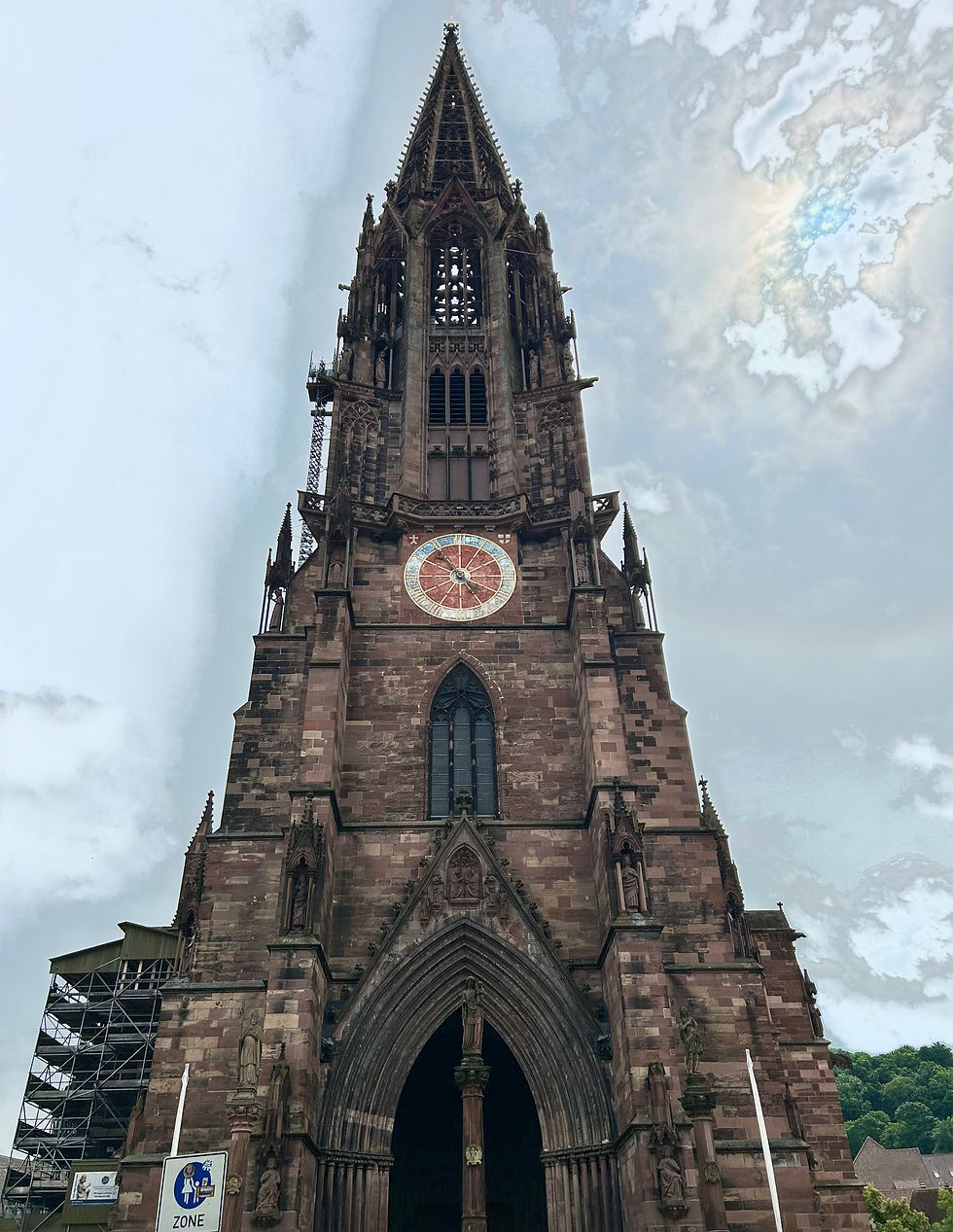
While traveling Europe, you will constantly come face-to-face with larger-than-life churches, especially larger-than-life Catholic churches. The churches are grandiose, spectacularly decorated, and always seem to imitate that candlelit mood lighting, which I find unironically romantic. This post is inspired by the approximately 300-year construction of Freiburg Minster, though that extended timeline for church construction is not unique when looking across Europe.
Yes, Minster. This name comes from the word for monastery and is just another name for a church. Interchangeable but with slightly differing origins: Dom means domus, or house of the bishop, and cathedral comes from cathedra, seat of the bishop. Important churches in Germany often start with Minster. The meanings of these words are confusing, as I would assume domus would be referring to the house of God, not the house of the bishop. But maybe it does, and I am just unaware. At least according to the official plaques inside the Minster Freiburg, it's referring to the house of the bishop, not God.
This kind of self-aggrandizement shouldn’t be surprising, considering the abounding contradictions within Christianity, and specifically their megachurches. The ornate decorations, bejeweled reliquaries, and priceless artworks certainly required lots and lots of money, which, at least according to religious tradition, is better spent on alms, not pointless decorations. Particularly when God probably doesn’t care if the altar is constructed from solid marble or driftwood (although I bet a driftwood altar is actually pretty awesome).
I would be lying, however, if I said the art didn’t astonish me. It does astonish me. There is simply not much not to be astounded by when looking at a megachurch like the Minster Freiburg. The ornate tops of the three towers are constructed peaks, featuring intricately spaced gaps that remind me of the Gothic rose seen on many churches, except without the panes and flat surface, opting instead to form the multi-sided shapes which culminate in a point at the top.
There are also countless painted statues regaling the large double doors, gargoyles (my favorite) adorning the sides of the church, paintings and more statues inside, and the afore-promised bedazzled reliquary of Saint Lambertus. I could not imagine sculpting, painting, or bedazzling even one of these pieces of art. The excess is overwhelming, but so are the works themselves.
I guess, honestly, I should not be faulting the artists who made these works. They simply followed their passions where the money was to be found, or so I like to think. The institution of the Catholic Church, by focusing its enormous wealth on rendering beautiful art, managed to facilitate the construction of some of the most impressive works still standing today.
Having grown up religious, but not necessarily supporting or identifying with the ideals and doctrines of the Catholic Church today, it is odd when I walk into one of these churches and suddenly feel a sense of comfort. I went to the Minster Freiburg and then went back the next day, visiting the site twice in a span of 24 hours, something I often do while sightseeing. The familiarity of the stained glass depicting the Stations of the Cross, the partially lit rows of candles, and the quiet space calmed my wandering thoughts. I almost felt nostalgia for the Catholicism I grew up with. More so, the act of the church and the comfort of the predictable rituals, not the doctrines.
I eventually found myself standing before a series of statues depicting Jesus and his Apostles at the Last Supper. Judas was easily spotted with his small bag of change, which, according to the legend, he received for selling Jesus out to the Romans. The rest of the Apostles I failed to identify, my Catholic education failing me. The familiar scene again evoked a feeling of nostalgia, and while I don’t necessarily believe in epiphanies, I can understand why people choose religion. More specifically, why people stick to religion when they are raised with it.
Traveling solo means you are, as the name states, alone. At the same time, you are most likely in an environment and place unfamiliar to the comforts and routines of your daily life. Solo travel can be isolating at times, especially when someone is used to talking to familiar people every day, even if it’s the cashier at your local grocery store. Oddly enough, Jesus and his Apostles hanging alone at the Last Supper were kind of like the local grocery store cashier. I found a sense of comfort and familiarity in their presence.
Extending this beyond my own experience, people who need to feel a connection to lost family members, friends, and others with whom they shared a community through religion can find it through practicing their faith, or maybe just simply by looking at something they associate with it. It’s strange to recognize the associations my consciousness makes with Catholicism. Its contradictions and teachings make me reject the religion, especially because the teachings come into conflict with my own person. But if someone never really has a reason to question their faith, why would they?
Regardless of my views, the “nostalgia of Catholicism” has a grip on me. The art and ambience of these grandiose spaces awe me and provide comfort in foreign places. The Catholic Church as an institution, despite its many open-faced flaws, persists as a powerful force in the lives of many. Religion can unconsciously heal loneliness and comfort people in the present, while promising this same comfort and happiness for eternity.


Comments